Welcome to our Blog!

The intent of our blog is to share with family and friends our two year journey living and working in Italy. To all of you who have visited or lived in Italy before, we welcome your suggestions for things to see. places to go, and people to meet!

Wednesday, December 21, 2011

First Adventure in Rome - the Sights

Rome is an amazing city! The history is rich and the blend of architecture over time is a strange and wonderful thing; relatively modern structures (1800s) standing next to 3000 year old Roman ruins, and then everything in between.

We stayed in the core of old Rome, within walking distance of the key sights. In fact our hotel, the Albergo del Senato is facing the Pantheon, on the Piazza della Rotondo. While this is not the low budget place to stay in Rome, it is a very nice hotel, English-speaking staff which is always helpful, and a perfect location to start with your first visit.

We traveled to/from Rome on the fast train, FrecciaRossa part of Trenitalia. It was a great experience-- so nice and quiet and smooth. On the fast train, you can be to Rome in less than an hour. The train stations are well organized and easy to get around. There are several other classes of trains for getting around Italy. After this experience, I am sure we will be taking them more often.

Here are just a few highlights of Rome:

Pantheon

Pantheon - Meaning Dedicated to All Gods
The size of the Pantheon is hard to describe. It is enormous and a wonderful feat of engineering and construction. Here are a couple of brief movie clips that show some of the architecture.


During the Christian era, the Pantheon was rededicated as a church and an altar and statues were added.


Around the outside of the Pantheon you can see the brickwork and supporting arch structure that the Romans are known for. The straight, strong walls still standing today are testimony to it's efficacy.

Side door


Colosseum
Our guide was a scholar and very knowledgeable about the history. She works at the university half the year and spends the other part of the year when school is not in session, leading tours and such. I recommend this as the way to go if anyone wants to tour Rome. We overhead the public tour and saw the group on 25 people tromping past. Compared to the tour we had, it was very anemic.

So one thing she clarified about the Colosseum is that there were many types of games and entertainment that went on here. Originally, it was a lake and naval games were played here. Later it was drained and built up to accommodate a variety of games. Gladiators were paid competitors and not slaves fighting for their lives, although certainly at times that also happened. Many of the games were hunting sport games where the animals that were unleashed through the myriad of trap doors from below.

If you can imagine the Colosseum covered in marble, then you can visualize what it was like. Today very little marble remains. The marble was stripped from the ruins in the 1500s and much of it used to build the Vatican.

The people and busses nearby show you the size of the Colosseum

Walkway around the periphery

More examples of Roman brickwork

Most of the 2nd and all the 3rd story are missing

The maze of corridors under the main floor


Forum
I always thought the Forum was a building but in reality it is an area of the old Rome where the markets, temples, courts, and social gathering places were. There is a lot of interesting information about the Forum and excavations are still going on. Here is a link that is a good introduction

The Roman Forum

View of the valley, "The Forum"

Temple of Saturn

Cemetary in forefront


Area Sacra di Largo Argentina
Uncovered in the 1920s by a building project, this is another site still undergoing excavation. It has the remains of four different temples and what is believed to be the Teatro di Pompey where Julius Caesar was assassinated in 44BC.
Site of excavations 

Notice the many layers of Rome; this site was actually much lower than the current city
This shows you the area of Rome where this is
Area Sacra di Largo Argentina | Rome | Italy | Ancient Rome | Historvius


Home of the No Kill Cat shelter


Vatican

Vatican City is actually it's own country with it's own police, laws, taxes, army, hospitals, transportation, etc. The Pope is king and everything that lives and works there is screened for their dedication to the Catholic religion. That was a bit eye-opening to us and some of the Italians around us grumbled because they pay such a high burden of taxes and the people in Vatican City don't pay any. Hard to know or understand how that all works but we did not see any evidence of need or neglect within Vatican City, so apparently whatever system they use takes care of the people.

It is huge. We spent 5 hrs. there and barely scratched the surface. We toured the Vatican museum which is actually several multi story buildings plus courtyard, St. Peter's Basilica, and the Sistine Chapel. There are many other buildings we did not see. The artwork is fantastic. I would have loved to spend hours just staring at the beautiful frescos, the mosaics, tapestries and statues. But even on a private tour like we had, you are barely in one hall for 10 min. and there are still lots of people around so it is difficult to linger. And of course, the signs are all in Italian.

So if you visit Vatican City, get a private English-speaking guide and do your homework in advance so you know more of what you are looking at.

In Vatican Museum - Roman statuary


Vatican Museum - one of the many awesome rooms with painted ceiling


St. Peter's Basilica - Many rooms with vaulted ceilings all in mosaic

Alter in St. Peter's Basilica

Johnnie and I both struggled with the religious/spiritual side of Vatican City. It is an ostentatious display of wealth, beyond my imagination. The statues to the various popes (their mummified corpses are on display there -- some in glass cases) and the Virgin Mary are prominent; only one statue of Jesus and that one with him laying dead in Mary's arms.

In the Vatican Musuem are lots of statues of Roman gods, and it seems incongruous to us to have a Christian shrine with statues  of other gods along side.

The Roman archeological sites (such as Pantheon, Colosseum, and Forum) were pilfered by the Catholic Church in the 1500s during the era of the building of the Vatican and brought to Vatican for display. Marble and bronze were pulled off the Roman temples and reused likewise.

The explanation of the design of the St. Peter's Basilica (various doors, ceremonies, special days of observance) and Sistine Chapel have lots of tradition and stories of miraculous sightings behind them; much of it without Biblical basis. I know that every church and denomination have traditions beyond strictly speaking what is in the Bible, but here we seemed to encounter more tradition than Biblically-based teaching or model for the way the church should worship.

So we thoroughly wondered at the marvelous artwork and architecture of Vatican but walked away wondering "What would Jesus think about all this?"

Wednesday, November 30, 2011

At The Castel Dell'Ovo

The Castel Dell'Ovo, means Egg Castle. Not too romantic sounding to me, but it is a prominent landmark in Bay of Napoli. Right across from the popular tourist hotels on the waterfront, I actually lived across the street for almost a month and never toured through the castle. Today was the day, so we walked over to the castle to look around.

Entrance to Castel Dell'Ovo


First you need to know the story behind the castle.

Commune Napoli


"Castel dell' Ovo stands on the islet of Megaride. According to one of the most fanciful Neapolitan legends, the name of this castle derives from the egg that the Latin poet Virgil apparently hid in a cage placed in the dungeons of the castle. The egg was locked up and kept hidden because "the fortune of the Sea Castle depended on that egg".


Wikipedia says

The island of Megaride was where Greek colonists from Cumae founded the original nucleus of the city in the 6th century BC. Its location affords it an excellent view of the Naples waterfront and the surrounding area. In the 1st century BC the Roman patrician Lucius Licinius Lucullus built the magnificent villa Castellum Lucullanum on the site. Fortified by Valentinian III in the mid-5th century, it was the place to which the last western Roman emperor, Romulus Augustulus, was exiled in 476.[1] Eugippius founded a monastery on the site after 492.
The remains of the Roman-era structures and later fortifications were demolished by local residents in the 9th century to prevent their use by Saracen raiders. The first castle on the site was built by the Normans in the 12th century. The importance of the Castel dell'Ovo began to decline when king Charles I of Anjou built a new castle,Castel Nuovo, and moved his court there. Castel dell'Ovo became the seat of the Royal Chamber and of the State Treasury. The current appearance dates from the Aragonese domination (15th century). It was struck by French and Spanish artillery during the Italian Wars; in the Neapolitan Republic of 1799 its guns were used by rebels to deter the philo-Bourbon population of the city.
In the 19th century a small fishing village (Borgo Marinari) developed around the castle's eastern wall. This village remains, now known for its marina and restaurants.

What it is today
Without enough Italian language to read and understand all the signs about, we can merely show you photos at this point and give you some of our first hand observations.

The castle is extremely compact. By castle standards -- at least in my own imagination of what a castle should be -- this one is very small. Looks are deceiving however, when you get inside there are amazing passage ways all over and multiple levels. Tourist access is really only to the outer walkways and the one upper floor. There are at least two other levels visible that we could not access. I believe some of the rooms on the lower level are used now for special events.


This passage way is a gradual climb of steps but with very shallow rise. We speculated that a horse and cart could make this grade and because of how wide the path is, was probably used as a main passageway for bringing supplies and arms into the castle.


Close up of the ceiling supports

Perfectly arched contours on these ancient walls
The stones used to build this castle are huge. I can't fathom how they were quarried, moved, cut and placed for this structure. Several comparisons of us next to the walls give you perspective to see how thick and heavy they must be. Keep in mind, this latest version of the castle was 16th century, so think about the technology available at the time. Today they stand firm and straight as they were placed 600 years ago. Wow, what an amazing feat of engineering! What do we build today meant to last 600 years?


From the main passage are dozens of narrow, winding staircases leading to where, we don't know. 


The views of from the castle are beautiful. From a defensive and strategic point of view, this was an ideal location as no one could "sneak up" on you. Being situated in a deep water bay, it was also ideal of shipping and trade.


All good castles have gun ports ( or perhaps they are for archers?) ringing the outer edges. These are cleverly designed so the inside access is much larger that the outside openings.


There is also an upper level with canons at the ready.

Roof top canon battlement

View southeast from the castle to the adjacent area with marina and restaurants
After the tour of the Castle, we went next door to one of the many little cafes that ring the castle. This marina has some very beautiful boats and is a nice location to pass away a sunny afternoon.

Pavers typical of all historic Naples

View of the castle wall from the Marina cafe

Enjoying Sunday afternoon


Saturday, November 26, 2011

At the Park

Villa Communale is a beautiful city park along the waterfront of Naples. It used to be the private gardens of the Princess who lived in our palazzo (palace). The park is over 1 km long and has the traditional things you would expect to see in a park: walking paths, gardens, fountains, statuary, pigeons, people riding bikes, people walking dogs, and then of course the kiddie play area with rides and snack bar. You can rent go carts, and foot-pedal powered carriages. This park also has booths setup every Sunday for local merchants to bring in produce, meats, cheeses, and other food stuffs.

History
It was first built as a paved road between Piazza Vittoria and Piedigrotta by the Spanish viceroy Duke of Medinaceli in 1697 who adorned it with thirteen fountains and two rows of willow trees on each side. Later, it became a Royal Promenade known as Villa Reale and sitting directly on the shore, provided a much needed buffer between the hustle and bustle of the city to the north and the tranquil sea to the south.


… between the street and the sea, is the villa Reale the fashionable promenade. On one side the waves kiss the wall, and if you like you may sit for hours in the seats provided and dream of coral graves and purple mullets. Or you may walk in nicely-graveled paths, beneath palms, orange trees and bowers of blooming laurestinas, even though it be March. The whole air is full of perfume, and the promenades are thronged with the flush and the fair. Dick Tinto, New York Times, January 22, 1858 

That however was in the days when women donned gowns to stroll through the park and when only the rich, the royals, and the famous graced its promenade. That is except for once a year on September 9th during the Festa di Piedigrotta, when all citizens were welcomed into the park, provided of course that they wore shoes. The Neapolitans still flock to Villa Comunale to celebrate that festival today.

Quoting from Napoli Unplugged website


Today
Johnnie and I are privileged to live right across the street from this lovely park. They do not water in the summer so when we first came, everything was brown and rather dusty. But with the rains this Fall, the the plants and trees have turned green again and the dust settled so it is quite lovely. We took some photos last Sunday which do not do it justice but how can you capture on film the spirit of a place?


One of the many fountains


Many walking paths throughout the park

Lots of shade trees


The park is part street market, part amusement park, and part botanical gardens. It might be compared to Balboa Park in San Diego only on a smaller scale. The very old Stazione Zoologica Anton Dohrn of Naples is an aquarium built in 1872 by the German scientist Anton Dohr (seen in the background of photo above). Small by today's standards, this aquarium is still functioning and displays fish from the surrounding waters. Marine research is still performed here. Johnnie went through this aquarium one day and it took him about 20 min. to see it all. He was expecting it to be on multiple floors but when he tried to go upstairs one of the guards shook his finger and said "No, no, no".


Old and young alike use this park. We enjoyed a leisurely stroll, sitting on the park bench watching people, and of course, feeding the ever-present park pigeons.


Pedal powered vehicle for those who want exercise


Battery powered child size go carts

We find these go carts on the sidewalks outside the park wherever the children leave them. The park attendants patiently go around and retrieve them all at the end of day.


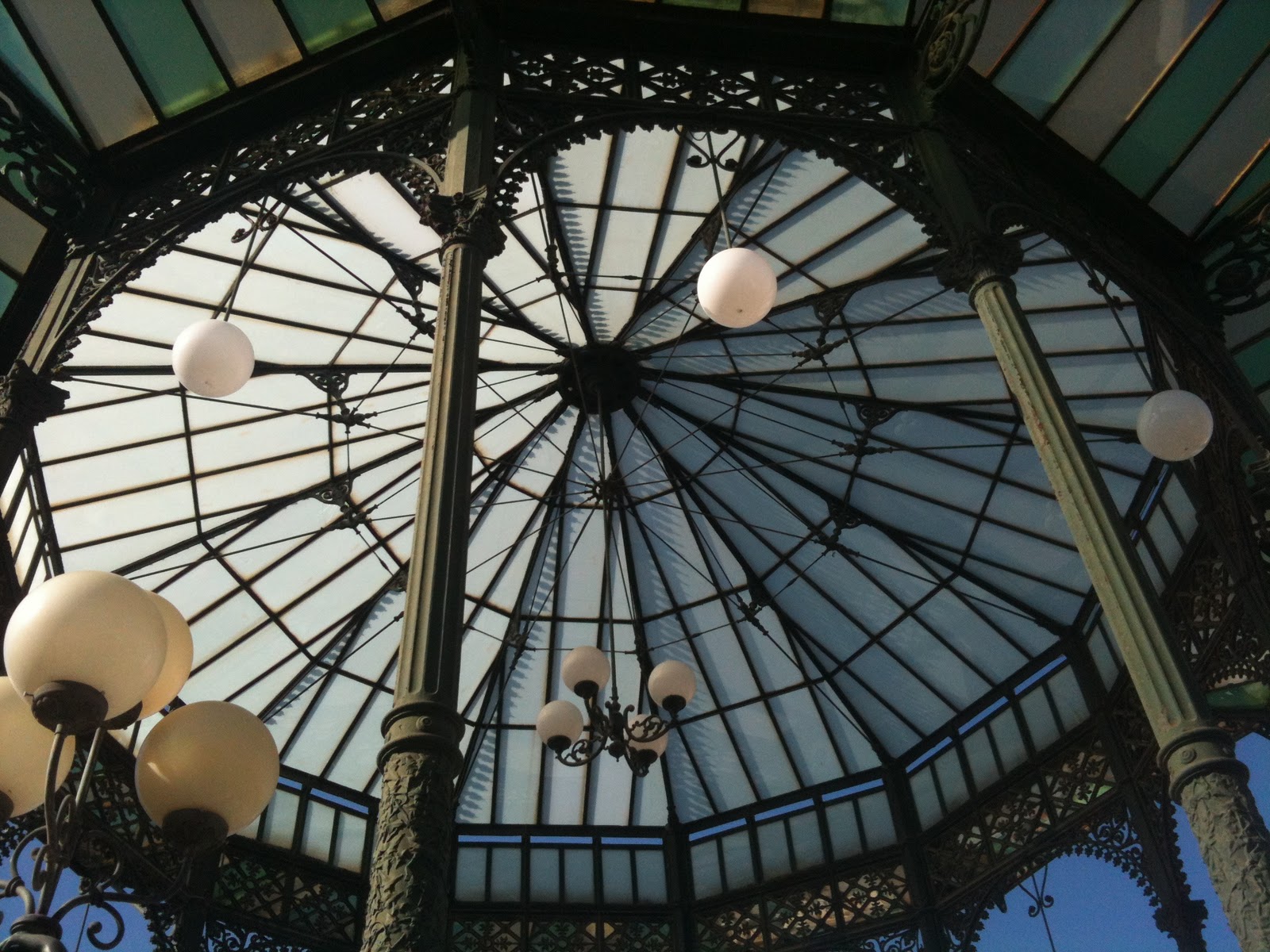
This is a very neat bandstand with stained glass dome. It was chained off last Sunday but presumably is open for special events, weddings, concerts, etc. Looking at the inside of the roof structure, I thought it was an interesting design and construction. The frame and supports are all metal -- steel I guess -- and the decorative edges are very fine and lacey.


There are lots of statues in the park placed by during the late 1800's and early 1900's that honor different heroes of Naples. This particular statue has no inscription so I don't know who he is, however, this is housed in it's very own building as seen in the photo below.
In addition to all previously mentioned is a roller skating rink, swing set and jungle gym, and an assortment of antiques and collectibles as well as some tourist junk. We have only explored part of this lovely park and look forward to many fine Sunday afternoon strolls here in future


Sunday, November 20, 2011

At the Street Markets

Street markets are everywhere, tucked into narrow lanes, they are setup and torn down daily in several areas around our neighborhood. Some are mainly soft goods, some food stuffs. 


Naples
Johnnie discovered the other day that some of the vendors are illegally selling (without a license or paying the appropriate taxes to the government). He was walking along the street when suddenly there was a rapid commotion of people breaking down their carts and running for the allies quickly. The Guardia di Finanza who I characterize as the modern day tax collectors, raid these areas where the illegal street vendors gather. It seems to be a regular occurrence and as soon as the Guardia have moved on, the street vendors are back. These people have small, very portable displays.


Other street vendors are of a more permanent nature and must pay their taxes since they don't appear to be harassed by the Guardia, and they are in the same locations day after day. Here in our neighborhood, they setup by 9am and generally are shutting down by 1pm. They have this process down to a fine science and can do it in short order.

This one street near us has mostly clothing and fabrics. Their merchandise looks to be good quality, so I will be checking them out in future.
One side of the street is all booths


Dodging scooters and cars while you shop is part of the experience
I believe it is acceptable to bargain. I noticed very few price tags which always suggests to me that things are negotiable. 


Martina Franca
This past week I traveled to Grottaglie on business. We stayed in Martina Franca because it is a much nicer place for Johnnie during the day. It is a very clean, traditional Italian town with lots of places to walk, shops, coffee bars, and many things close at hand.


Martina Franca Taranto Italy


The street market in Martina Franca is a traveling market that goes between several small towns in the area. They are in MF on Wednesday mornings. When I left for work at 7:30am they were already setting up and I had to wind my way carefully through the booths since it basically takes over the streets for several blocks around our hotel. It is a huge market compared to the small ones around us in Napoli.


Johnnie got out and wandered and took all these photos I will share with you. It is an amazing market and the streets were crowded with people from 8 until 1pm. Prices seem to be good and everything from women's clothing to fabric to fish were for sale.


Street market in Martina Franca


Lots of fresh vegetables for sale


Johnnie bought a shirt and a couple fly swatters. As always it is the food that really amazes us though. Prices are Euros per kilo, so you have to do a bit of math to compare with what we pay. But even without the math, street market prices are lots cheaper and the food is fresh, grown locally.


Many varieties of fagioli


http://maps.google.com/maps?client=safari&rls=en&q=martina+franca+map&oe=UTF-8&um=1&ie=UTF-8&hq=&hnear=0x1346530a3eb94a63:0xc713613896281a7f,Martina+Franca+Taranto,+Italy&ei=0lDHTo_yN4vRsgaChInvBg&sa=X&oi=geocode_result&ct=title&resnum=1&ved=0CDAQ8gEwAA